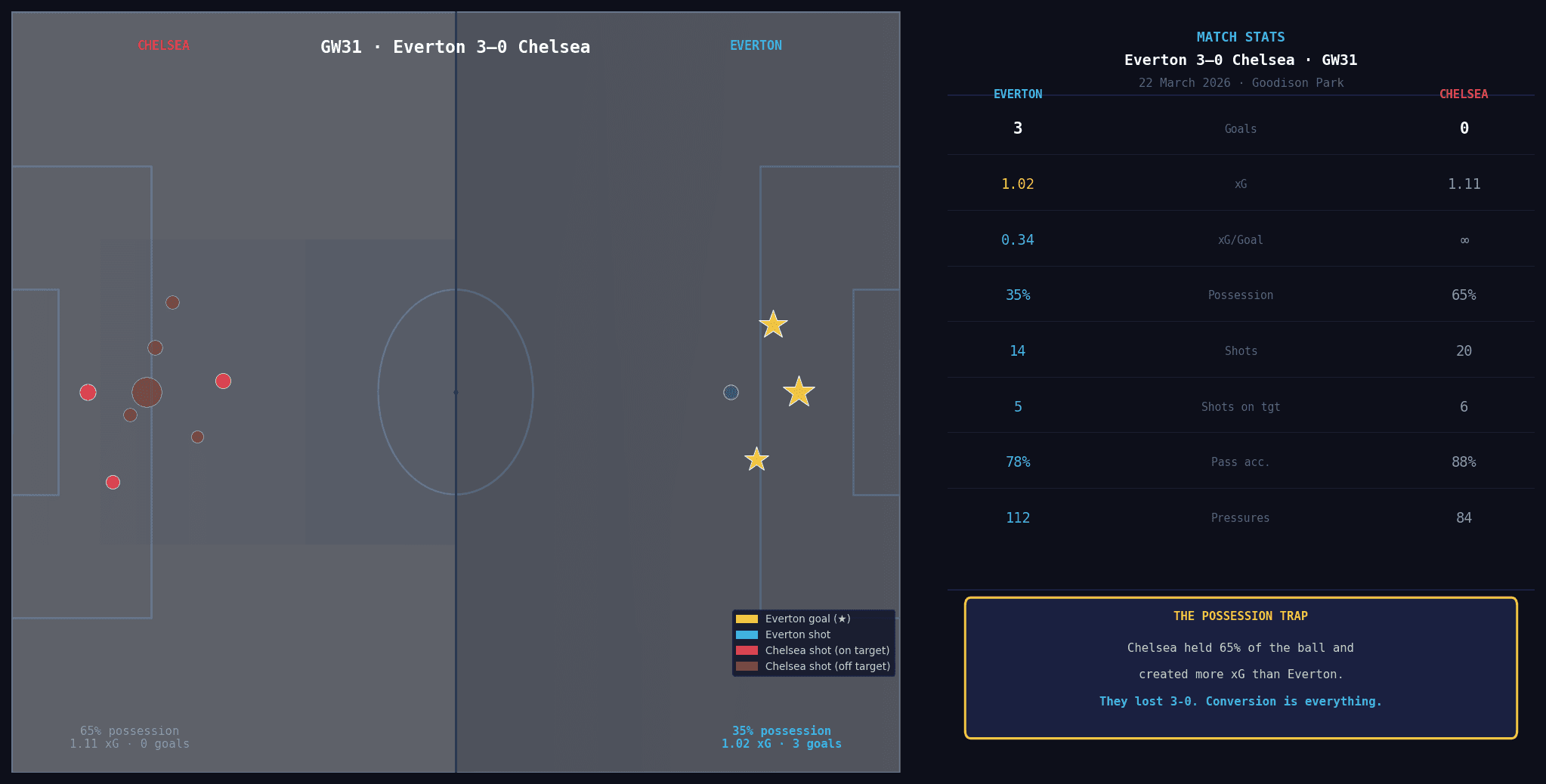
Chelsea had 65% of the ball at Goodison Park. They generated 1.11 xG to Everton's 1.02.
They lost 3-0 to a team that touched the ball for barely a third of the match.
That gap — 1.11 xG to 0 goals — is not a fluke. It's a system working exactly as designed.
The Trap
Sean Dyche's Everton don't want the ball. Never have. They want your decisions — the ball circulation that feels like control but is actually just feeding a low-block that knows exactly where the danger is coming from.
Chelsea pushed 88% pass accuracy and 20 total shots. Impressive, until you look at where those shots came from. Fourteen of those twenty attempts came from outside the penalty area or from angles the goalkeeper treated as non-events. The xG model registered 1.11 because it saw volume. What it couldn't register was the quality of the defensive structure those shots were hit into.
Mykhailo Mudryk attempted four dribbles. Won zero. Enzo Fernández completed 94 passes. None of them opened a line to goal.
The Counter That Wasn't
Everton's three goals came from a combined 1.02 xG — just over a third of an xG per goal. That number is deceptive in the other direction. These weren't scrambled efforts. Beto finished both his chances with the composure of a striker who knew exactly when the opportunity was arriving.
The mechanism: Everton sat in a mid-block, invited Chelsea to push their full-backs high, then sprung their press on the turnover. Idrissa Gueye — 38 years old, still reads the first pass better than anyone in the Premier League — won the ball twice in dangerous positions. Everton didn't need to create chances from open play. Chelsea created the space for them.
The third goal, from a set piece in the 71st minute, came after Chelsea had already committed men forward chasing an equaliser that never felt like it was coming.
The Possession Trap
Chelsea's 65% possession is almost perfectly designed to look like dominance. It isn't. It's territory on the left flank, slow build-up against a team that doesn't press, crosses into a 6'3 centre-back, and recycled possession that never punched through the first line of Everton's shape.
Cole Palmer — 31 touches, 0 shots on target. That sentence tells you more about this game than any possession statistic.
The problem isn't that Chelsea are bad. It's that they played a team who have been drilling this shape for three years and understand exactly how to make possession expensive. When you don't have a striker who can play in behind — and right now Chelsea don't — you're giving Everton everything they want.
What It Means for GW32
Everton are now unbeaten in six. This isn't a run built on luck. It's a run built on a repeatable mechanism that catches possession-heavy sides who mistake the ball for control.
Chelsea face Arsenal next. Arsenal will press. The dynamics flip entirely.
The question for Enzo Maresca isn't whether his system is working — it clearly isn't, three clean sheets conceded in four. The question is whether he has the personnel to play a different way when the opposition removes the space his system needs.
At Goodison, they didn't.